
In recent months, the United States Government has signaled a commitment to tackling the Autism crisis by investing in research to identify the causes. In September 2025, Secretary of Health and Human Services (HHS), Robert F Kennedy Jr, led a one hour press conference from the Oval Office, where he announced a multi-department commitment to tackling the autism epidemic which now affects nearly a third of the country’s children.
Following the Press conference, HHS issued a press release announcing “bold new actions to confront the nation’s autism spectrum disorder (ASD) epidemic”. The release, along with a fact sheet, reported that ASD rates have surged 400% since 2000, with 1 in 31 American children now affected. In California, where tracking methods are reportedly the best, ASD rates are highest with 1 in 12.5 boys diagnosed.
HHS unveiled a $50 million investment across 13 projects to “transform Autism research” by integrating “large-scale biological, clinical, and behavioral data with an exposomics approach that examines environmental, nutritional, medical, and social factors alongside genetics.”
The U.S. Government also highlighted several possible contributing factors, including cerebral folate deficiency and the use of acetaminophen which reportedly reduces the levels of a key antioxidant, glutathione, in vulnerable individuals.
That same month, the U.S. Senate’s Permanent Subcommittee on Investigations interviewed U.S. Economist Toby Rogers who received his PhD at University of Sydney on “The Political Economy of Autism”. Rogers submitted a written statement that warned of a huge cost burden and advised further investigation into the underlying causes in order to develop a prevention strategy that averts a “fiscal cliff” of Autism costs.
Toby Rogers, PhD, University of Sydney, presents to the U.S. Senate on the Cost of Autism
In his statement, Rogers highlighted several alarming facts, including that the prevalence of autism has risen from 1 in 10,000 from the 1970s to 1 in 31 today—a 32,158% increase in the last 52 years. Rogers also noted that the search for “the gene for autism” has consumed over $2.3 billion, yet results have been very limited. He explained that “claims that autism is genetic don’t make sense because autism prevalence was rising too fast — there’s no such thing as a genetic epidemic.”
Autism Tsunami: The Impact of Rising Prevalence on the Societal Cost of Autism in the United
The paper, on which much of Rogers’ testimony was based—Autism Tsunami: The Impact of Rising Prevalence on the Societal Cost of Autism in the United States (co-authored by Rogers, Mark Blaxhill and Cynthia Nevison)—highlights the alarming and unprecedented levels of ASD in the U.S.. Using modeling tools developed by Rogers, it also forecasts societal and economic costs.
Autism Tsunami projects a significant increase in both the prevalence of autism and the associated societal costs, with far-reaching implications for individuals, families, and governments. The paper provides a stark analysis of the future financial burden autism is expected to impose on the United States.
One of the key implications of this research is the projected shift in financial responsibility. The costs associated with caring for an individual with autism throughout their entire life is roughly $7.2 million per individual—an amount currently shouldered primarily by families but expected, as aging parents pass on, to shift largely to the government. Hundreds of billions of dollars currently paid by parents will soon shift from the household to the government, a cost that is projected to be greatly higher considering the growing number of people with autism. We will soon be facing, as Rogers puts it, a “fiscal cliff”.
Projecting the Costs of Autism Through 2060
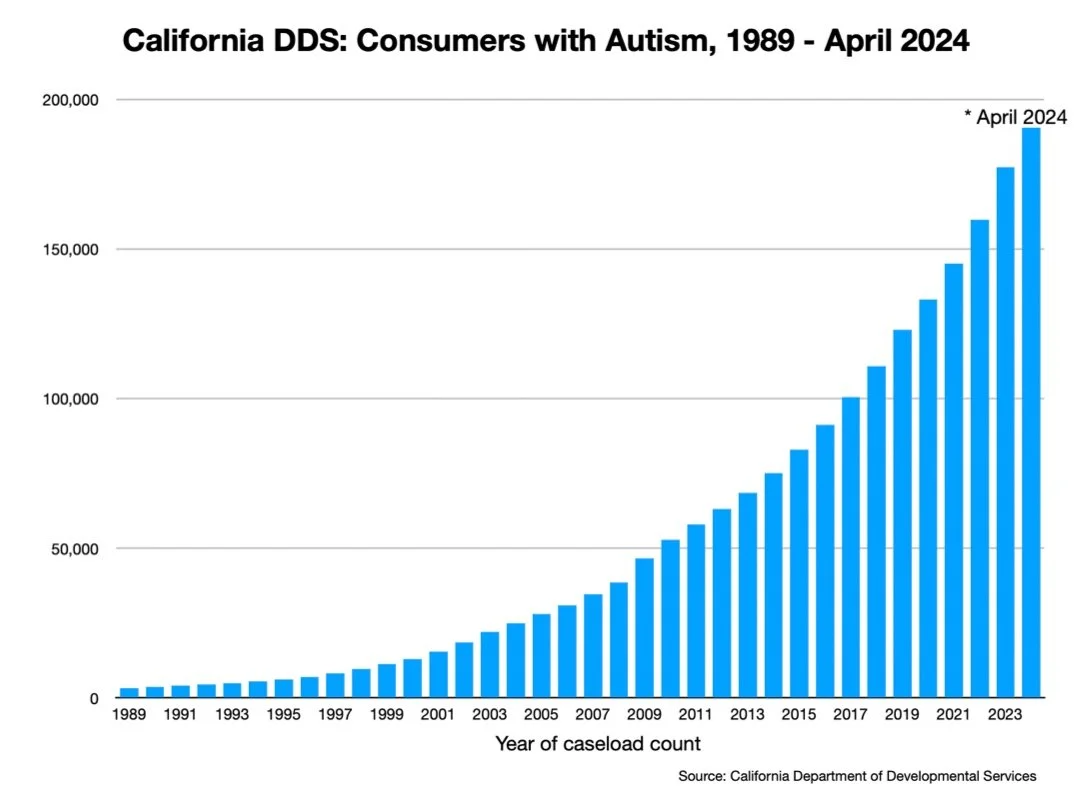
Autism Tsunami begins by examining historical data on autism prevalence and using it to forecast future trends. The authors estimate that the prevalence of ASD will continue to rise sharply, potentially exceeding 7% in children by 2032. The study uses a comprehensive model that factors in historical trends, costs per individual across multiple age groups, and inflation projections to estimate the total annual cost of autism in the U.S. up to 2060.
According to the study’s projections, the annual costs associated with autism in the U.S. will escalate from the current $238 billion to $589 billion by 2030, $1.36 trillion by 2040, and an astonishing $5.54 trillion by 2060. These figures represent a “tsunami” of expenses that will impact all levels of society.
Noteworthy Findings and Implications
One of the study’s key contributions is its dynamic model, which contrasts with previous static models that assumed linear increases in autism prevalence and costs. The fluid nature of the model allows for a more realistic projection of how rising autism rates will continue to drive up costs over time. This approach underscores the urgency of addressing the autism epidemic—not only from a health perspective but also from an economic one.
Another significant finding, as mentioned, is the projected shift in financial responsibility from families and local school systems to State and Federal Government, as parents and carers age and die. Housing costs and caregiving are among the highest. This shift poses a major challenge for public policy and fiscal planning, as governments will need to find new sources of revenue to cover these escalating costs.
The study also highlights the importance of prevention as a cost-saving measure. Given the projected financial burden, the authors argue that more attention should be paid to identifying and mitigating the environmental factors that contribute to the rising prevalence of autism. This could potentially slow or reverse the trend, thereby reducing the long-term economic impact.
Mitigating Environmental Factors_The Total Load Theory
As the authors discuss in the paper, the effects of this crisis can be tempered “via identifying and better regulating environmental factors that increase autism risk.”
Although autism is popularly understood to be largely genetic, evidence suggests otherwise. Genetic mutations account for less than 1% of all children with autism. Research indicates that while over 1,000 genes have been reported in association with ASD, many of these links remain unconfirmed. Most common gene variations only slightly affect risk, and not all individuals with these variations develop ASD.
By contrast, environmental factors have been shown to play a significant role. Maternal chemical and drug intolerances have been identified as potential risk factors for both autism and ADHD. More recently, a 2024 study suggested that exposures to toxicants such as heavy metals, organophosphate pesticides, and tobacco smoke may stimulate epigenetic changes in gene expression.
In her book, Total Load Theory, Patricia Lemer details a complex combination of nervous system stressors (e.g. infections, toxic metals, plastics, herbicides, nutrient deficiencies, EMF, muscular-skeletal and dental structure) impacting on sensory, motor, language and psycho-social development in children. She argues that ASD, ADHD, Learning Delay, anxiety and a range of brain and mental health conditions are downstream of an overburdened body and overstressed nervous system.
Drawing on his review of over 1,000 studies, Rogers concluded that toxic exposures are major contributors to rising autism and chronic disease rates, urging immediate action to reduce these hazards. The $50 million investment in exposomic research is a promising start.
Autism in Australia
In Australia, the most recent government report on autism was published in 2022. Findings showed a 41.8% increase between 2018 (.8%) and 2022 (1.1%). 3.1% (1 in 33) Australians under the age of 25 and 4.3% (1 in 23) between the ages of 5-14 are living with ASD. This is an alarming increase from the prevalence of Autism in children aged 0-15 in the late 90’s of 0.489%. Strikingly, almost three quarters of those with ASD (73%) had a “profound or severe disability”.
Hopefully the Australian Government, like the HHS, will invest more in understanding the causes and solutions to the surge in Autism. Without proactive measures, the financial burden of autism could become unsustainable, leading to severe economic and social consequences in Australia.

A Hopeful Future
Autism Tsunami offers hope by making a compelling case for looking beyond genetics when it comes to understanding the cause(s) of Autism. We have an opportunity to address modifiable risk factors associated with Autism. If well-designed research takes into account vulnerable individuals impacted by environmental stressors, perhaps researchers can uncover what combination of stressors interacts with genetics and biology (e.g. metabolic & digestive) in which individuals. The findings may offer insights into drivers of chronic illness epidemic which has emerged over the same time period as Autism.
A Call to Action
Autism Tsunami’s findings are a wake-up call for policymakers, healthcare providers, and society at large. The authors stress the need for governments to start planning now for the impending financial crisis that will result from the continued rise in autism prevalence. This includes not only securing the necessary funding but also implementing strategies to prevent new cases of autism and better support those who are already affected.
Functional Practitioners Address Environmental Causes
Functional Medicine is an emerging field which focuses on a “total load” approach by identifying and eliminating the underlying causes of disease (e.g. toxins, infections, nutritional deficiencies, EMF, chronic stress) and their impact on our interconnected body systems (metabolic, immune, neurologic, digestive, endocrine, microbiome.)
Functional Medicine practitioners specialise in identifying and treating environmental factors causing illness. This specialty is not yet offered via traditional medical school curricula, but an increasing number of talented practitioners are training in this science-based modality via independent educational organisations. A well-trained functional medicine practitioner will take a comprehensive history to identify potential environmental factors (toxins, infections, nutritional deficiencies, stress) and follow with lab testing to determine and address root causes. This personalised and precise approach to healthcare offers hope for effective treatment of environmentally-driven health conditions such as autism.
For a list of Functional Practitioners visit https://directory.mindd.org/